

Your Parents Did Their Best And Their Best Still F*cked You Up (And That's Allowed To Be True)

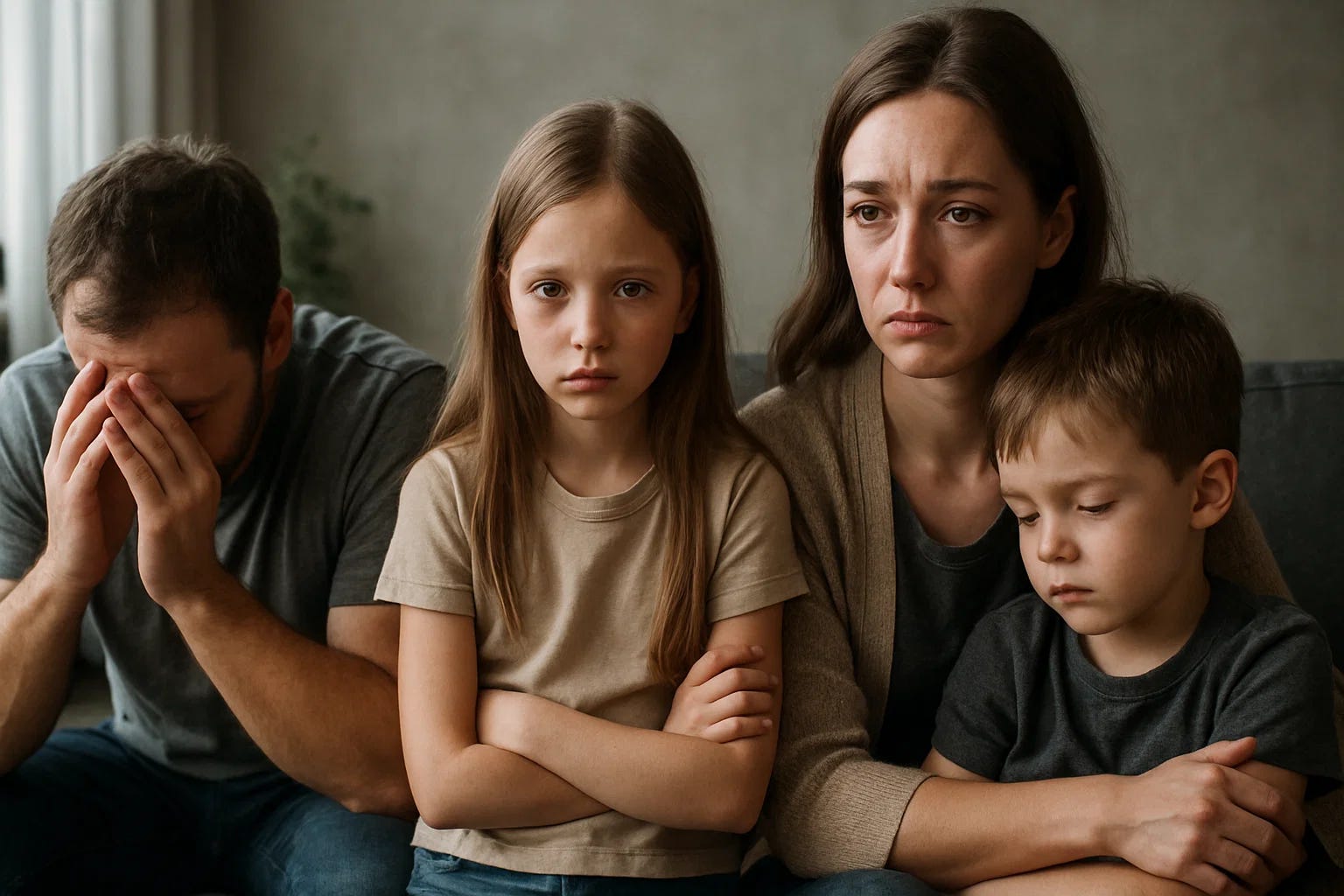
Two things can be true at the same time.
They loved you. And they damaged you.
They tried. And they failed.
They did better than their parents did. And they still passed down wounds you’re carrying right now.
This isn’t about blame. It’s about honesty.
And most of us have never been allowed to be honest about this.
The Script We’re Given
From the time you could understand words, you were handed a script about your parents.
“They sacrificed everything for you.” “They did their best with what they had.” “You should be grateful.” “Family is everything.” “Honor your mother and father.”
And if you felt something other than gratitude, something was wrong with you. Ungrateful. Selfish. Spoiled.
So you learned to bury it.
You learned to feel guilty for your own pain. To minimize what happened. To make excuses for behavior that would be unacceptable from anyone else but somehow gets a pass because it came from family.
You learned that loyalty means silence.
And you’ve been silent ever since.
What We’re Actually Talking About
I’m not talking about monsters. This isn’t about the obvious cases of abuse that everyone agrees are wrong.
I’m talking about regular parents. Good enough parents. Parents who showed up to your games and made sure you had food and genuinely believed they were doing right by you.
This isn’t about broken homes. This is about homes.
Parents who also:
Criticized you until your inner voice sounds exactly like them.
Dismissed your emotions until you stopped trusting yourself to feel.
Compared you to siblings or cousins or neighbors’ kids until you believed you were never enough.
Controlled every decision until you couldn’t make one without anxiety.
Made you the parent when you were still a child because they couldn’t hold their own shit together.
Projected their unlived dreams onto you until you didn’t know which goals were yours.
Used guilt as a management tool until obligation became your primary emotion.
Made love conditional on performance until you became an achievement machine that can’t feel joy.
None of this makes them evil. All of it made you who you are. And some of what you are is wounded.
That’s not drama. That’s just true.
Why We Protect Them
Here’s what I’ve learned about why we defend the people who hurt us.
It’s not about them. It’s about us.
If your parents were flawed but trying, your childhood makes sense. It was imperfect but it was real and it was survivable.
But if your parents harmed you, then something terrible happened. And that means you were a child who was harmed. And that’s a harder thing to sit with.
Defending them protects us from having to grieve.
Grieving that the childhood we deserved isn’t the one we got. Grieving that the people who were supposed to protect us were sometimes the source of the danger. Grieving the relationship we wanted with the parents we actually have.
That grief is brutal. So we skip it. We defend instead.
“They meant well.” “They didn’t know any better.” “It wasn’t that bad.” “Other people have it worse.”
All of these might be true. None of them erase the wound.
The Guilt Is A Lie
You feel guilty for even reading this. I know because I would have felt guilty too.
The guilt says: How dare you criticize the people who raised you. How dare you focus on the negative when they gave you so much. How dare you be anything other than grateful.
The guilt is a control mechanism. And it was installed on purpose.
Children who feel guilty are easier to manage. They don’t ask questions. They don’t push back. They don’t hold adults accountable because they’re too busy feeling bad about their own existence.
That guilt followed you into adulthood. It shows up every time you try to set a boundary. Every time you consider distance. Every time you acknowledge that something they did still affects you.
The guilt says you’re betraying them by being honest.
Honesty isn’t betrayal. Silence is self-betrayal.
The Permission You’re Looking For
Here it is:
You’re allowed to love your parents and be angry at them.
You’re allowed to appreciate what they gave you and grieve what they couldn’t.
You’re allowed to understand their limitations and still hold them responsible for the impact.
You’re allowed to acknowledge that they were doing their best and that their best wasn’t good enough.
You’re allowed to stop pretending it didn’t hurt just because it wasn’t intentional.
Intent doesn’t erase impact. Someone can step on your foot by accident and your foot still bleeds. You don’t have to pretend it doesn’t hurt just because they didn’t mean to.
Your parents stepped on parts of you. Maybe they didn’t mean to. It still left marks.
What This Isn’t
This isn’t permission to become a victim forever. Your wounds are real and at some point the healing becomes your responsibility even though the injury wasn’t your fault.
This isn’t an excuse to blame every problem in your life on your childhood. You’re an adult. You make choices. Some of your shit is on you.
This isn’t a script for confrontation. You don’t have to tell your parents anything. Acknowledgment can be internal. Healing doesn’t require their participation or their permission.
This isn’t about cutting people off. Some people need distance. Some people can repair. That’s your call based on your situation.
This is just about truth.
The truth that something can be well-intentioned and still cause harm. That good people can create bad outcomes. That the people who loved you most might also be the source of some of your deepest wounds.
And that acknowledging that isn’t betrayal.
It’s the beginning of healing shit you’ve been carrying alone.
The Thing Nobody Tells You
Here’s what I wish someone told me earlier:
You can grieve parents who are still alive.
You can mourn the relationship you wanted while still having some version of one.
You can love people and recognize they’re not safe for you.
You can understand their trauma and still not accept it as an excuse for how they treated you.
You can forgive them and still have boundaries.
You can hold all of this at once without choosing sides.
And yeah, it’s exhausting. Welcome to being a person who actually looks at their shit instead of burying it like everyone else at Thanksgiving.
The people who tell you it’s one or the other, that you either defend your parents completely or you’re an ungrateful child, are people who haven’t done their own work.
They need you to stay silent so they don’t have to look at their own shit.
That’s not your responsibility to manage.
What Happens When You Tell The Truth
When you stop pretending, you stop performing.
When you stop performing, you start feeling.
When you start feeling, you grieve.
When you grieve, you process.
When you process, you release.
When you release, you stop passing it down.
That’s the whole point. Not to punish your parents. Not to be a victim. Not to dwell in the past forever.
The point is to stop the cycle.
Your parents probably inherited wounds from their parents who inherited wounds from their parents. Unprocessed pain gets passed down like genetics. Nobody means to do it. It just happens when you don’t look at it.
Looking at it is how it stops.
Telling the truth about what happened to you is how you stop happening to someone else.
The Real Conversation
This is the conversation your family never had.
This is the thing that gets avoided at holidays and buried under small talk and drowned in whatever coping mechanism your family uses to not feel.
Nobody wants to talk about it. Nobody wants to be the one who says it out loud.
So everyone pretends. And the pretending becomes the culture. And the culture becomes the next generation.
Until someone breaks.
That’s not failure. That’s courage.
The one who says “this happened and it affected me” is the one who changes everything for everyone who comes after.
Even if your family never acknowledges it.
Even if they call you dramatic.
Even if they close ranks and make you the problem for having the audacity to name reality.
You still told the truth. And that truth lives in you as something clean now.
The Only Point
Your parents did their best.
Their best still f*cked you up.
Both are true.
You’re allowed to say it out loud.
And maybe that’s the truest thing you’ve let yourself think in a while.
—Cody Taymore
Kill The Silence
If this gave you clarity, peace, or just helped you feel a little less alone — and you want to support more work like this — you can leave a small tip here.
Parental damage is a hard road to travel, let alone to process and understand.
Becoming a parent can either soften the blow or make it incredibly worse.
Personally, when I became a mom, 33 years ago, it made my anger towards my mother worse. Just how could you not love and protect your own daughter, when it came so easy and natural to me?
Here I am, 33 years later (my mom’s been dead 38 years) and I can say, I have grasped some of what my mother may have been dealing with with her own family issues, issues with men, self esteem, etc. but I don’t think I will ever know what happened that she hit a switch around the time I was 8 and just had pure hatred for me.
She’s not here to answer anything or be angry at, so it didn’t serve me to follow in her footsteps
This is such a great explanation of something very complex to navigate. Thanks for putting words to the feelings so many people have.