

The Silent Trauma Bond: 7 Signs You’re Still Psychologically Tethered to Your Abuser
Breaking the Invisible Chains: Why Your Brain Stays Connected Even After You've Left

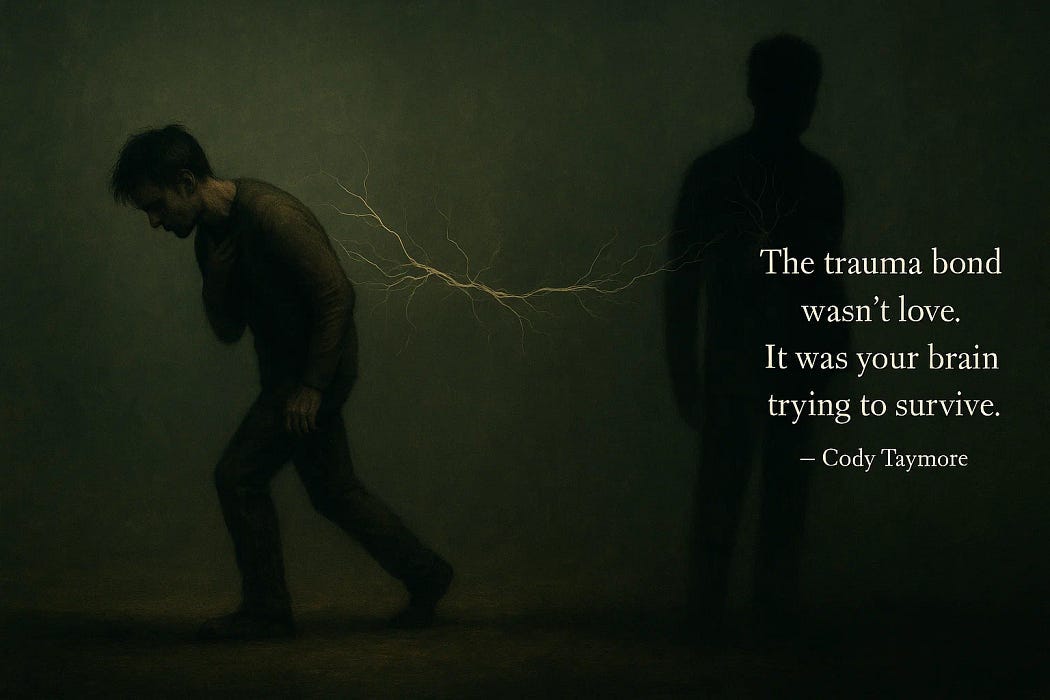
Your abuser is gone. But the invisible chain still pulls.
You’ve left physically. You’ve blocked the number. You’ve changed the locks. You’ve done everything right.
So why do you still feel owned?
The Neurobiological Prison No One Talks About
What you’re experiencing isn’t weakness. It’s not love. It’s not poor boundaries.
It’s a trauma bond — a biochemical tether as real as any physical chain.
Science confirms what survivors already know in their bodies: trauma bonds aren’t just emotional. They’re neurobiological. They restructure your brain chemistry, creating addiction-like responses to the very person who’s destroying you.
This isn’t metaphorical. Your brain on abuse produces the same patterns of attachment, craving, and withdrawal as a drug addiction. The same flooded pathways. The same desperate relief when the source returns.
The cycle of abuse and intermittent reward creates addiction pathways more powerful than cocaine. This isn’t an exaggeration — it’s neuroscience.
But here’s the part no one tells you: recognizing these bonds is the first step to breaking them.
The Silent Epidemic of Misdiagnosed Symptoms
Before we dive deeper, let’s address the misdiagnosis that keeps so many survivors stuck. The symptoms of trauma bonding are frequently mislabeled as:
Depression (when it’s actually grief and withdrawal)
Codependency (when it’s actually biochemical attachment)
Poor boundaries (when it’s actually traumatic freezing)
Obsession (when it’s actually your brain seeking resolution)
This misdiagnosis often leads well-meaning people to offer advice that deepens your shame rather than addressing the root cause. They tell you to “just let go” when what you’re experiencing isn’t a choice but a neurobiological response requiring specific intervention.
Think of it this way: you wouldn’t tell someone with a broken leg to “just walk it off,” yet that’s effectively what we tell survivors still bound by invisible chains. Understanding the true nature of trauma bonds isn’t just validating — it completely reframes the path to recovery.
7 Signs You’re Still Trapped in a Trauma Bond
1. You experience withdrawal symptoms when cutting contact.
Anxiety spirals. Racing heart. Insomnia. Obsessive thoughts. Physical pain.
These aren’t just emotions — they’re your nervous system in withdrawal.
Your body learned that the abuser was both the source of danger and the source of relief. Now that they’re gone, your brain is screaming for the relief part, even if it comes packaged with pain.
This is why “just move on” is such useless advice. Your body isn’t choosing this response. It’s been biochemically programmed for it.
2. You minimize the abuse in your own mind.
“It wasn’t that bad.” “Other people have it worse.” “They were just struggling.” “I provoked them.”
This mental rewriting isn’t random. It’s a defense mechanism.
Because if the abuse wasn’t “that bad,” then the devastating impact it had on you makes sense. If it was truly terrible, then you have to face the full reality of what happened — and what’s still happening in your body.
Your brain would rather downplay the abuse than confront the trauma.
3. You alternate between demonizing and idealizing them.
One moment, you see them clearly as the manipulator they were. The next, you’re flooded with memories of “the good times.”
This cognitive dissonance isn’t a character flaw. It’s your brain struggling to integrate contradictory experiences.
The person who hurt you also provided moments of what felt like love. Your neural pathways formed around both experiences, creating a fragmented attachment that doesn’t fully villainize or idealize.
This split perception keeps you psychologically tethered, always cycling between clarity and confusion.
4. You feel a magnetic pull to check on them.
Social media stalking. Driving past their place. Asking mutual friends for updates.
You know it’s not healthy, but the compulsion feels irresistible.
That’s because it’s not just curiosity. It’s your brain seeking a dopamine hit from any connection, no matter how one-sided or self-destructive.
The checking behaviors temporarily soothe the craving, but ultimately strengthen the bond you’re trying to break.
5. You experience identity collapse without them.
“Who am I without the chaos?” “What do I even want anymore?” “I don’t recognize myself.”
Abusive relationships systematically dismantle your sense of self, replacing it with a version that orbits around the abuser’s needs and moods.
When they’re gone, that adapted identity has no purpose. The void isn’t just missing them — it’s missing the version of you that evolved to survive them.
This identity confusion isn’t weakness. It’s the aftermath of psychological colonization.
6. Your body still responds to triggers as if they’re present.
A text notification sends your heart racing. Someone using their phrasing makes you freeze. A door slamming triggers a panic attack.
Your nervous system doesn’t know the danger is gone. The hypervigilance, the fight-flight-freeze responses, the cortisol spikes — they’re all still active.
This isn’t “being dramatic.” This is your brain’s threat detection system still calibrated to an environment of unpredictable danger.
The body keeps the score long after the game has ended.
7. You still organize your life around avoiding their disapproval.
“They wouldn’t like this outfit.” “They would criticize this decision.” “They wouldn’t approve of this relationship.”
Even in their absence, their judgments still colonize your choices.
You’re still living within the invisible fence they built around you. Still feeling the shock collar of their disapproval even when they’re not there to administer it.
Their voice has become your internal critic, continuing their work even in their absence.
The Truth About Breaking Trauma Bonds
Here’s what the “just get over it” crowd doesn’t understand: trauma bonds aren’t broken through willpower alone.
You can’t just decide not to feel the pull. You can’t rationalize your way out of a neurobiological response any more than you can think your way out of a broken bone.
Breaking a trauma bond isn’t about being “strong enough.” It’s about:
Recognizing the bond exists. Naming it as a biochemical attachment, not love or weakness.
Understanding the neuroscience. Your brain physically restructured around the abuse cycle. This isn’t imagination — it’s biology.
Treating it as addiction recovery. Complete detachment, supportive community, and patience through the withdrawal symptoms.
Recalibrating your nervous system. Using somatic practices to teach your body that safety exists without the abuser.
Rebuilding identity outside the bond. Rediscovering who you are when you’re not organizing your existence around someone else’s reality.
Breaking free isn’t a single decision. It’s a neural rewiring project.
The Timeline Nobody Tells You About
One of the cruelest aspects of trauma bonding is the unpredictable timeline for healing. While the acute withdrawal symptoms might peak in the first 6–12 weeks after separation (similar to drug addiction), the deeper neurobiological healing can take significantly longer.
This isn’t a reflection of your strength or commitment to recovery. It’s simply the reality of how long neural rewiring takes. Some pathways established during prolonged trauma can take 1–2 years to fully recalibrate, especially if the abuse occurred during formative periods or lasted for many years.
Understanding this timeline doesn’t mean resigning yourself to suffering. Rather, it allows you to set realistic expectations and celebrate the small victories along the way.
The frequency and intensity of the pull will diminish over time, even if it doesn’t disappear as quickly as you’d hope.
Recovery isn’t linear. You’ll have days of clarity followed by sudden regressions that feel like you’re back at square one. This isn’t failure — it’s your brain strengthening new pathways while the old ones gradually weaken through disuse.
The Most Important Truth: It’s Not Your Fault
The shame of still feeling attached to someone who hurt you can be overwhelming.
“What’s wrong with me that I still care?” “Why can’t I just hate them and move on?” “Am I actually the toxic one?”
Let me be absolutely clear:
Nothing is wrong with you. Your brain is doing exactly what brains do when subjected to trauma. This is a normal response to abnormal treatment.
The trauma bond wasn’t created because you’re weak. It was created because you’re human.
Your neurobiology responded exactly as it’s designed to when faced with unpredictable cycles of pain and relief from the same source.
The very attachment that tortures you now was initially your brain’s survival mechanism. It was your mind trying to create predictability in chaos. Trying to find patterns in randomness. Trying to secure safety where none existed.
You didn’t choose this attachment any more than you would choose an addiction.
What you can choose now is the path to liberation — not through shame or self-blame, but through understanding the invisible chains before you can break them.
And you will break them. Not because you’re suddenly “strong enough.” But because you now understand what you’re actually fighting: not weakness, but neurobiology. Not poor boundaries, but biochemical tethers. Not love, but trauma.
The first step to freedom is naming the prison.
— Cody Taymore
Very very important! Thank you so much for this--so many empathic people need to know this. It's easy to feel shame and to make ourselves wrong when we simply were needing healing. Please keep writing and telling everyone this -- I wish I had known years ago.
Wow, Cody, this is a really well-crafted article, and something I can relate strongly to. Tell you what, I really wish I'd read something like this about four or five years ago when I was going through the unwinding of my own worst trauma bond, one that in the discard phase triggered a re-traumatizations of my worst day of childhood. It almost killed me (the plug is, I wrote about it..follow me if that's if interest).
No article to guide me and very much on my own (I never did theapy and I make no apologies for that), I did have a couple of insightful people suggest 'trauma bond'. Only a couple. And I really hung on to that for dear life because most of the advice was along the lines of what you're talking about—the well-meaning but very destructive advice like 'let it go' and 'just think about something else' and 'you just sound obsessed'.
I did get through it eventually, talking years here, with the help of some insightful fellow travelers, myself, and my spiritual life, and a whole ton of shadow work and inner child work, which is still ongoing. And that's why I'm on Substack, actually. I started writing about it last year in real-time, and it seems like we're on similar paths, so I'm really glad to have come across yours.
Thank you for the article. 🙏