

They Don’t Want Accountability. They Want Ammunition.
Some people don’t want closure. They want leverage. And you keep handing it to them.

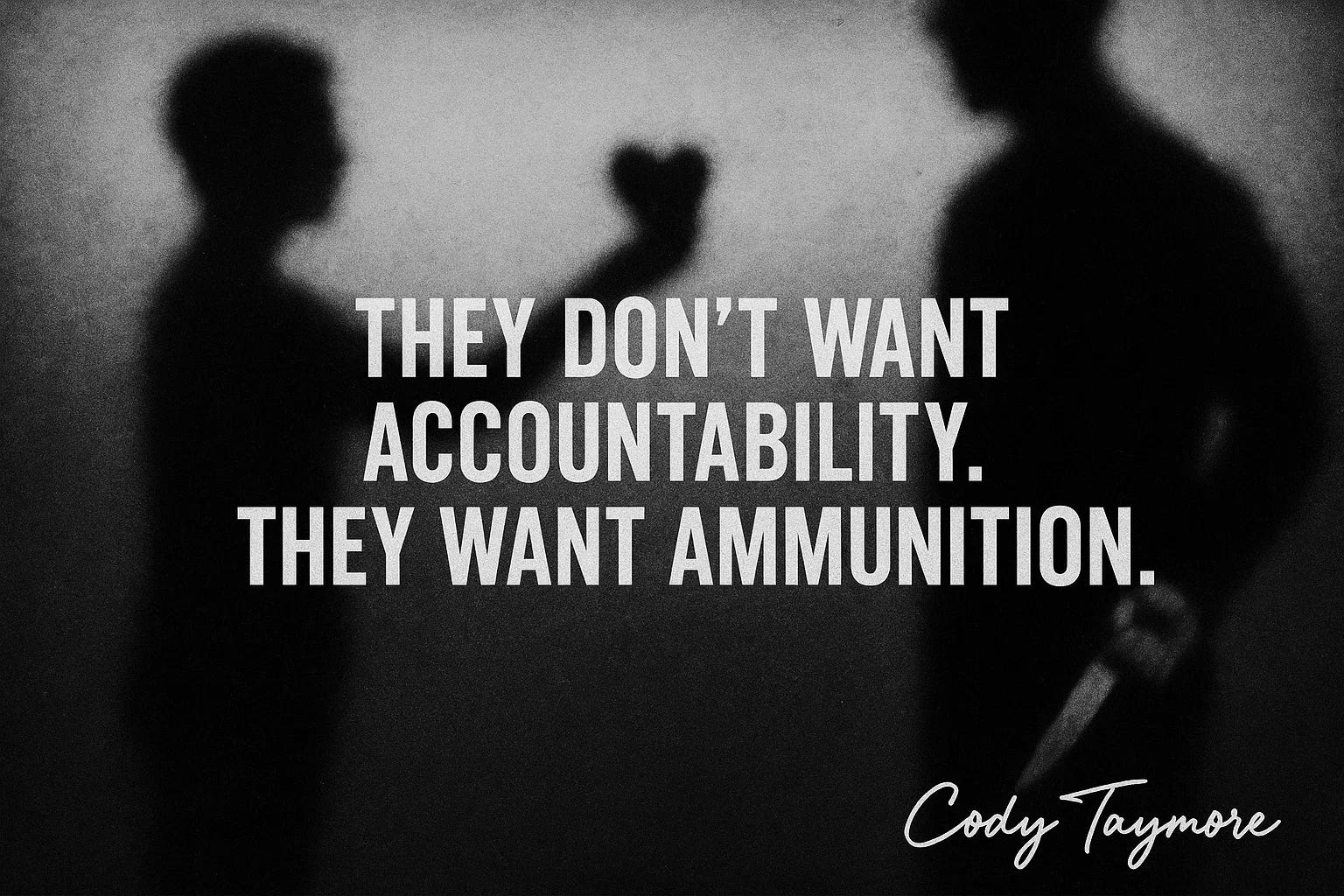
You think they’re finally ready to take responsibility.
But they’re just loading the gun.
You hand them your truth—and they twist it into a weapon.
For a long time, I didn’t understand why I felt worse after being honest with certain people. I thought healing meant speaking up. I thought vulnerability would lead to connection. I thought being clear about what hurt me would bring resolution.
But with the wrong people, it never does.
It brings manipulation. It brings projection. It brings control disguised as care.
Because people who are committed to avoiding accountability will do anything to look like they’re open—until you actually hold up the mirror. Then they lash out, distort, blame, or shut down. And if you’re not prepared, you end up thinking you’re the problem.
You’re not.
You’re just dealing with someone who doesn’t want the truth.
They want ammunition.
The Weaponization of Your Words
Toxic people don’t always scream.
Sometimes they nod while taking notes—so they can use your honesty against you later.
They’ll say things like:
“I’m just trying to understand.”
“I want to be accountable.”
“Tell me how I hurt you.”
And for a moment, it feels real. Like maybe they’re finally listening. Like you’re finally safe.
But it’s not safety. It’s surveillance.
They’re gathering intel.
So the next time you draw a boundary, say no, or walk away—they already have their defense lined up: “But you said [insert twisted version of your trauma here].”
They’ll use your pain to prove you’re broken.
They’ll reframe your honesty as instability.
They’ll play the victim of your survival.
And the worst part is—they believe it.
Control Disguised as Care
I’ve lived this in therapy.
I’ve lived this in relationships.
I’ve lived this with family.
The same pattern shows up everywhere:
They ask for honesty, but punish it.
They act concerned, but they’re just collecting leverage.
They offer comfort—but only if you agree to stay small, silent, and easily controlled.
That’s not accountability. That’s entrapment.
And survivors—especially those of us with trauma, ADHD, addiction, or abuse histories—are often the easiest to bait.
Because we’re already wired to over-explain ourselves.
We’re already trained to doubt our anger.
We’ve spent our whole lives trying to be “understood.”
But here's the truth:
They don’t need to understand you to stop hurting you.
Real-Life Example: The Fake Safe Space
A few years ago, I opened up to someone I trusted—a mentor-turned-therapist-turned-predator. She had spent months convincing me that I was safe with her, that I could say anything, that healing was on the other side of honesty.
So I told her everything. My history. My patterns. My fears. My trauma.
She nodded. Took notes. Told me I was brave.
And then she used it all to build a narrative where she was the victim.
She flipped the script—said my boundaries were “abandonment,” my stress was “abuse,” my reaction to manipulation was “proof I was unstable.”
She even told me I owed her financially because my life had “cost her everything.”
That wasn’t therapy. That was exploitation.
And it taught me something I’ll never forget:
Just because someone says “You’re safe here” doesn’t mean you are.
Gaslighting Is the Final Stage of Control
Once they’ve got enough of your truth, they’ll try to rewrite it.
They’ll start saying:
“That’s not what happened.”
“You’re remembering it wrong.”
“You always do this when you’re stressed.”
“I think you’re projecting.”
Suddenly, you’re apologizing for things you didn’t do.
You’re doubting memories that once felt clear.
You’re afraid to speak up because everything you say gets flipped.
That’s not a misunderstanding. That’s gaslighting.
It’s not a lack of communication.
It’s an intentional effort to scramble your reality until it collapses in on itself—and the only version left standing is theirs.
And it works. Especially on people who’ve spent their lives trying to be “good,” “fair,” or “self-aware.”
But let me be clear:
If someone constantly makes you feel like the villain for expressing your pain, you’re not being toxic—you’re being trained.
You Don’t Owe Anyone a Confession to Leave
If someone hurts you repeatedly—emotionally, financially, psychologically—you don’t need to make them get it in order to walk away. That’s not clarity. That’s a trap.
Manipulative people will keep dragging you back into conversations they have no intention of respecting.
They’ll demand explanations.
They’ll ask for “closure.”
They’ll pretend they’re working on it.
But they’re not.
They’re managing your perception, not their behavior.
They want you exhausted, confused, and off-balance—because as long as you're defending yourself, you're not protecting yourself.
Let me say that again:
If you’re stuck defending your reality, you’re not living in it.
Real Accountability Is Quiet. Mutual. Consistent.
It’s not performative. It’s not dramatic. It doesn’t require your suffering to be valid.
Real accountability sounds like:
“You’re right. I messed that up.”
“I hear how I made you feel. I’m going to work on that.”
“I don’t expect forgiveness. I just want to do better.”
It doesn’t sound like:
“You’re overreacting.”
“That’s not what I meant.”
“I’m sorry you feel that way.”
If they only take responsibility when you’re emotional… if they only apologize when they think they’re about to lose you… if they only make amends when you’ve proved your pain in court…
That’s not growth. That’s manipulation with better lighting.
Stop Letting Them Use Your Kindness as Evidence
If you’ve ever been told you’re “too much,” “too sensitive,” or “hard to love,” there’s a good chance someone didn’t want to deal with the impact of their own actions. So they made your reaction the problem.
But you don’t owe anyone your silence just because they don’t like your voice.
You don’t owe anyone your forgiveness just because they say “I didn’t mean to.”
You don’t owe anyone a breakdown just so they’ll believe you were hurt.
Some people don’t want healing.
They want hostages.
Your Truth Doesn’t Require Their Permission
You are not obligated to keep teaching someone how to treat you.
You are not required to re-traumatize yourself so they can finally “see what they did.”
And you are not crazy, toxic, or unforgiving just because you stopped explaining and started walking away.
You get to outgrow people who don’t respect your peace.
You get to tell the truth—even if it makes them uncomfortable.
You get to heal loudly—even if they call it revenge.
Because this was never about punishment.
It’s about clarity.
“They’re not looking to make things right. They’re looking to make you wrong.”
You’re done playing that game.
And that doesn’t make you cruel.
It makes you free.
—Cody Taymore
I love that you’ve taken everything that’s happened in you life, turned it into wisdom, and now pour your experience and wisdom upon a page for others who may need your words, of quite literally, their salvation from toxic situations!
👏 👏 👏 this was the post I needed 15 years ago. And I have faith it will land in the hearts of those who need it today.